The premium corporate gifts supplier in Malaysia
Non-woven bags are eco-friendly promotional bags made from polypropylene fabric. In Malaysia, they typically cost RM0.80 to RM5.00 per piece depending on size, thickness (measured in GSM), and order quantity. They're perfect for corporate events, retail giveaways, and exhibitions because they're lightweight, durable, and can be custom printed with your logo.
Most common specs: 90-100 GSM thickness, can carry 4-7kg, available in 20+ colors, minimum order 100 pieces.
Let's clear this up right away because the name is confusing — non-woven bags aren't made without weaving, they're made from polypropylene fibers that are bonded together through heat and pressure instead of traditional weaving.
Think of it like this: regular fabric is threads woven together (like a basket). Non-woven fabric is more like compressed paper towels — fibers pressed and bonded into a sheet. This process makes them cheaper to produce, lighter in weight, and easier to print on than traditional woven materials.
The technical term is PP spunbond (polypropylene spunbond), and it's the same material used in medical masks, furniture covers, and agriculture sheeting. For bags, this means they're surprisingly strong for how light they are.
Three reasons non-woven bags exploded in Malaysia over the past decade:
The downside? They're not 100% biodegradable (polypropylene takes 20-30 years to break down vs plastic's 500+ years). But they're recyclable and way better for the environment than single-use plastic.
Not all non-woven bags are created equal. Here are the main categories you'll run into:
This is your basic, reliable non-woven bag. Made with 90gsm fabric, carries up to 4kg, and comes in virtually any color you want. The "ultrasonic" part means the seams are heat-welded instead of stitched — makes them slightly cheaper to produce.
Best for: Trade shows, exhibition giveaways, retail stores
Why it works: Cheap enough to give away generously, sturdy enough that people actually use them. That large flat surface is perfect for logo printing.

Step up to 100gsm and you get noticeably better quality. Stitched seams instead of ultrasonic, can carry 5kg, and the fabric feels more premium. Comes in 8 bright contrast colors.
Best for: Corporate events where you want decent quality without breaking the bank
View Product →These are genius for roadshows and events where people need to carry stuff around all day. They fold down to pocket size with a snap button, then open up to full tote size when needed.
The play: People keep these in their car, purse, or backpack. Every time they use it, there's your logo. That's long-term brand exposure.
Pricing context: 100 pcs = RM5.00 each | 400 pcs = RM3.60 each (that's the sweet spot)
View Product →The big brother of foldable bags. When opened, this thing is massive — A3 paper size with 200mm depth. Perfect for grocery runs or carrying bigger items. Still folds flat with velcro closure.
Best for: Supermarkets, eco-conscious campaigns, anyone targeting shoppers

Now we're getting fancy. This one has an inner pocket (for phones, wallets, keys), velcro closure, and 100gsm thickness. Comes in 10 different colors.
When to use this: Corporate gifts for employees, client appreciation gifts, or when you want recipients to actually keep using the bag.
View Product →
Extra wide handle (200mm), dual reinforced straps, 100gsm fabric. This is built for heavy use. The two-tone color scheme also makes it look more upscale than standard single-color bags.
Use case: When you're giving away heavier items or want the bag itself to be the main gift
View Product →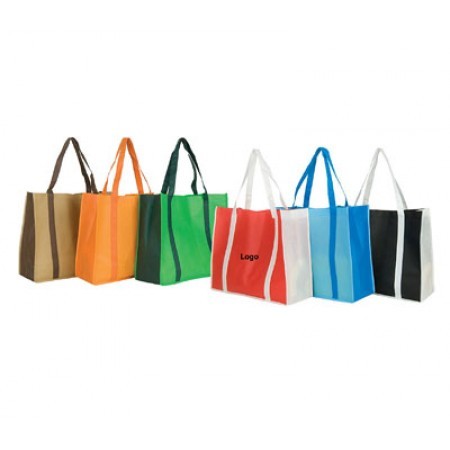
These have a glossy PET lamination coating that makes the colors pop and allows for full-color photo-quality printing. The lamination also makes them water-resistant and easier to wipe clean.
The catch: Higher MOQ (usually 500-1000 pieces) and longer production time, but the quality is noticeably better. Worth it for product launches or premium campaigns.
Customization options: You can choose your exact size, pantone colors, handle width (1.8-3.2cm), and finishing (cross stitch or ultrasonic)

Here's the truth about non-woven bag pricing in Malaysia — the price per unit drops significantly with quantity, so knowing your volume is crucial.
| Quantity | Budget Bags (80-90gsm) | Standard (100gsm) | Premium/Laminated |
|---|---|---|---|
| 100 pieces | RM 2.50-3.50 each | RM 4.00-5.50 each | RM 8.00-10.00 each |
| 200 pieces | RM 2.00-2.80 each | RM 3.50-4.50 each | RM 7.00-9.00 each |
| 500 pieces | RM 1.50-2.20 each | RM 2.80-3.80 each | RM 6.00-8.00 each |
| 1000+ pieces | RM 1.00-1.80 each | RM 2.20-3.20 each | RM 5.00-7.00 each |
Most suppliers (including Giftstalk) offer the best price-to-value ratio at 400-500 pieces. You get near-bulk pricing without committing to 1000+ units. If you're doing multiple events throughout the year, order 500 at once instead of 200 twice — you'll save 30-40%.
What affects the price:
You've got your bags, now you need your logo on them. Here's the breakdown of printing methods:
Cost: Cheapest option, usually included in bulk orders
Colors: 1-2 colors work best (each additional color = extra cost)
Quality: Clean, durable, won't fade easily
Best for: Simple logos with solid colors
This is what 90% of promotional bags use. Your logo is pressed onto the fabric with ink. It's bulletproof, looks professional, and doesn't add much to the per-unit cost.
Cost: Moderate, adds RM 0.50-1.50 per bag
Colors: Full color possible (great for detailed logos)
Quality: Good, but can peel over time with heavy use
Best for: Complex designs, gradients, photos
If your logo has multiple colors or you want photo-quality images, heat transfer is your move. The design is printed on special paper then heat-pressed onto the bag.
Cost: Most expensive, adds RM 2.00-4.00 per bag
Colors: Full CMYK color
Quality: Excellent, photo-quality, water-resistant
Best for: High-end products, retail bags, brand showcases
The print is embedded between the fabric and lamination layer, so it's protected and looks amazing. This is what you see at high-end retail stores.
Most suppliers charge a one-time setup fee for creating the printing plates/screens — usually RM 50-150 depending on complexity. This is separate from the per-unit cost. If you're reordering the same design later, you won't pay this again.
Malaysia has dozens of non-woven bag suppliers. Here's what actually matters when choosing one:
Standard production is 7-14 working days after artwork approval. Rush orders exist but cost 20-30% more. If you've got an event in 3 weeks, you're cutting it close — especially if you need sample approval first.
Smart move: Order 3-4 weeks out minimum. Order samples first if it's a large quantity or important event.
Most suppliers in Malaysia have a 100-piece MOQ for standard bags. Custom sizes or laminated bags might require 500-1000 pieces. If you only need 50 bags, you're going to pay nearly the same as 100 — so just order 100.
Good suppliers will provide blank samples for free or cheap (RM 5-10 per sample). Printed samples cost more but are worth it for large orders to check print quality before committing.
For orders over 500 pieces, always request a printed sample first. The GSM thickness, handle feel, and print quality can vary between suppliers even with identical specs. Spending RM 30-50 on samples can save you from a RM 2,000 disappointment.
This is the section everyone needs but nobody writes. Let's actually break down when to use each material, because choosing the wrong one wastes money and makes your brand look bad.
| Factor | Non-Woven | Nylon | Canvas | Paper | Plastic |
|---|---|---|---|---|---|
| Price Range | RM 1.50-5.00 | RM 3.00-8.00 | RM 5.00-15.00 | RM 0.30-1.00 | RM 0.10-0.50 |
| Durability (uses) | 30-40 uses | 80-100+ uses | 100+ uses | 1-3 uses | 5-10 uses |
| Print Quality | Good | Excellent | Excellent | Good | Fair |
| Eco-Friendly | Better than plastic | Moderate | Best option | Good if recycled | Worst |
| Weight Capacity | 4-7kg | 8-15kg | 10-15kg | 2-5kg | 3-8kg |
| Water Resistant | Moderate | Excellent | Poor (unless treated) | Poor | Excellent |
| Foldable/Packable | Yes (some styles) | Excellent | Bulky | No | Yes |
| Washable | Wipe only | Machine washable | Machine washable | No | Wipe only |
| Premium Feel | 2 stars | 4 stars | 5 stars | 1 star | 1 star |
The sweet spot: Affordable bulk promotional items
Choose non-woven when:
Skip non-woven if:
Real-world use cases: Annual dinners, trade show giveaways, retail shopping bags, university orientation packs, corporate event door gifts
The sweet spot: Active use, sports, outdoor events
Nylon (specifically 210D, 420D, or 600D denier) is tougher than non-woven and actually waterproof. The "D" rating tells you thickness — higher numbers = more durable but also more expensive.
Choose nylon when:
Skip nylon if:
Real-world use cases: Marathon sponsorships, gym membership gifts, outdoor festivals, sports teams, camping/hiking events, beach cleanups
Quality Nylon 420D Drawstring Bag — Popular for marathons and sports events. Lightweight, waterproof, folds tiny.
Black Base Nylon Tote Bag 600D — Heavier duty nylon for regular use. Button closure, can carry more weight.
iFashion Event Drawstring Bag — Scratch and water-resistant nylon. Perfect for outdoor activities.
The sweet spot: High-quality, long-lasting brand ambassadors
Canvas (usually cotton canvas, measured in oz like 6oz, 10oz, 11oz) is the premium option. Higher oz = thicker fabric = more durable.
Choose canvas when:
Skip canvas if:
Real-world use cases: Boutique retail bags, corporate employee gifts, client appreciation, book stores, farmers markets, eco-lifestyle brands, premium product packaging
ECO Canvas Tote Bag - 6oz — Lighter canvas, good middle ground between non-woven and premium canvas. Eco-friendly and affordable.
Cotton Canvas Tote Bag - 10oz — Premium thick canvas. This is what high-end brands use.
Pure Cotton Canvas Drawstring Bag - 11oz — Heavy-duty canvas in drawstring style. Can carry 5kg+.
→ Non-Woven
Best value for promotional giveaways. Good enough quality that people use them.
→ Nylon
Waterproof matters. Durability matters. People appreciate the quality.
→ Canvas
Worth the investment when perception is everything. Lasts for years.
→ Non-Woven
Only option that makes financial sense at scale without breaking the bank.
Smart companies use a tier system: Non-woven for general attendees (cheap, lots of them), Nylon for participants/active engagement (moderate cost, good quality), Canvas for VIPs/employees (premium, smaller quantity). This maximizes impact while managing budget.
Paper bags: Only use if legally required (banned plastic), single-use events, or ultra-budget (RM 0.30-0.80 each). They tear when wet and don't scream "quality."
Plastic bags: Avoid unless you have a specific reason. Many Malaysian states charge for plastic bags now, and the optics are terrible in 2026. Your brand looks behind the times.
Mixed materials (Non-woven + Canvas handles, etc): Marketing gimmick. You're paying more for something that's still mostly non-woven. Just get pure non-woven or pure canvas.
RPET (Recycled polyester): Good eco story if you market it right. Costs 20-30% more than standard non-woven. Only worth it if your brand is eco-focused and you tell customers it's recycled.
Here's a quick rundown organized by use case:
Winner: Ultrasonic Non-Woven Shopping Bag
90gsm, simple design, gets the job done. Order 500+ pieces to hit that sub-RM2 price point.
Winner: Two Tone Foldable Non-Woven Bag
People love the foldable feature, two-tone looks good, practical for everyday use. RM 3.60 at 400 pieces is solid value.
Winner: Non-Woven Bag with Inner Pocket & Velcro
The inner pocket and velcro closure make it feel premium. Employees will actually use these.
Winner: Ultrasonic Heat Press Non-Woven Bag
Large flat surface perfect for big logo printing. No pockets or fancy features to distract from your branding.
Winner: Large Utility Foldable Tote - A3
Big enough for actual grocery runs, folds flat for storage. Targets the eco-conscious shopper crowd.
See the complete collection: Non-Woven & Tote Bags Category
Quality non-woven bags (90-100gsm) typically last 30-40 uses before showing wear. Budget bags (60-80gsm) might only make it 15-20 uses. The handles usually wear out before the bag itself tears.
Sort of. You can wipe them down with a damp cloth, but machine washing isn't recommended — the heat and agitation can cause the fabric to warp or printed logos to fade. For bags that need regular washing, canvas is better.
They're significantly better than single-use plastic bags, but not as eco-friendly as canvas or cotton. Polypropylene takes 20-30 years to decompose (vs 500+ for plastic), and they're recyclable. The environmental benefit comes from reuse — if someone uses a non-woven bag 40 times instead of 40 plastic bags, that's a net positive.
GSM = grams per square meter. Higher GSM = thicker, more durable fabric. 80gsm feels thin and papery, 100gsm has more substance and can carry more weight. For promotional giveaways, 90-100gsm is the sweet spot. Below 80gsm starts feeling cheap.
Depends on your use case. Non-woven is cheaper (RM 1.50-5 vs RM 3-8) and better for large quantities at events where you're handing out hundreds of bags. Nylon is more durable, waterproof, and better for active/outdoor events like marathons or sports sponsorships. If people will use the bag outdoors frequently or in rain, go nylon. If it's for indoor events, shopping, or general giveaways, non-woven saves money without sacrificing too much quality.
Canvas (100% cotton) is the most eco-friendly — biodegradable and can last for years. Non-woven polypropylene is better than plastic (20-30 year decomposition vs 500+ years) and is recyclable. Nylon is durable so people use it longer (reducing waste), but it's still synthetic. Paper is eco-friendly if recycled but only lasts 1-3 uses. Best eco choice: canvas for longevity, non-woven for cost-effective reusability.
Sort of. You can wipe them down with a damp cloth, but machine washing isn't recommended — the heat and agitation can cause the fabric to warp or printed logos to fade. For bags that need regular washing, canvas or nylon are better options.
Yes, but usually only with laminated bags and higher MOQs (500-1000 pieces). Standard sizes are cheaper because suppliers already have the dies/molds. Custom sizing adds 10-20% to costs and 1-2 weeks to production time.
Yes, but usually only with laminated bags and higher MOQs (500-1000 pieces). Standard sizes are cheaper because suppliers already have the dies/molds. Custom sizing adds 10-20% to costs and 1-2 weeks to production time.
Standard timeline: 7-14 working days after artwork approval. Rush production (3-5 days) is sometimes available for 20-30% extra. Factor in 2-3 days for samples and artwork back-and-forth before production starts.
Most suppliers (including Giftstalk) can work with your logo file and place it on the bag for you. If you want a completely custom design with graphics beyond just a logo, you might need to provide print-ready artwork or pay for design services. File formats: AI, EPS, or high-res PDF work best.
For Giftstalk and most Malaysian suppliers, 100 pieces is the standard MOQ for off-the-shelf designs. Custom/laminated bags might require 500-1000 pieces.
Look, buying non-woven bags isn't rocket science, but there are enough variables that it pays to think it through. Here's the decision tree:
If budget is your main concern: Go with 90gsm ultrasonic bags, order 500+ pieces for best pricing, stick with 1-2 color silk screen printing.
If quality matters more: 100gsm stitched bags with features (pockets, velcro), consider heat transfer for better print quality, 200-400 pieces is fine.
If brand image is everything: Laminated bags with full-color printing, custom sizes if needed, invest in samples first, 500-1000 piece MOQ.
If you're not sure: Start with the Two Tone Foldable Non-Woven Bag — it's the safe middle ground that most people are happy with.
Events always need more bags than you think. Someone drops one in a puddle, you meet unexpected VIPs, your team needs some for follow-up meetings. Order 10-15% more than your exact count. The per-unit price is nearly the same anyway, and you'll thank yourself later.
Browse Giftstalk's full collection of non-woven bags: View All Non-Woven Bags
Or if you want to explore other eco-friendly options:
Questions about bulk pricing, custom printing, or need samples? Contact Giftstalk's sales team through their website or WhatsApp — they're pretty responsive.
About This Guide: This buyer's guide was last updated in January 2026 based on current market pricing and product availability in Malaysia. Prices and specifications may vary. Always confirm details with suppliers before placing orders.